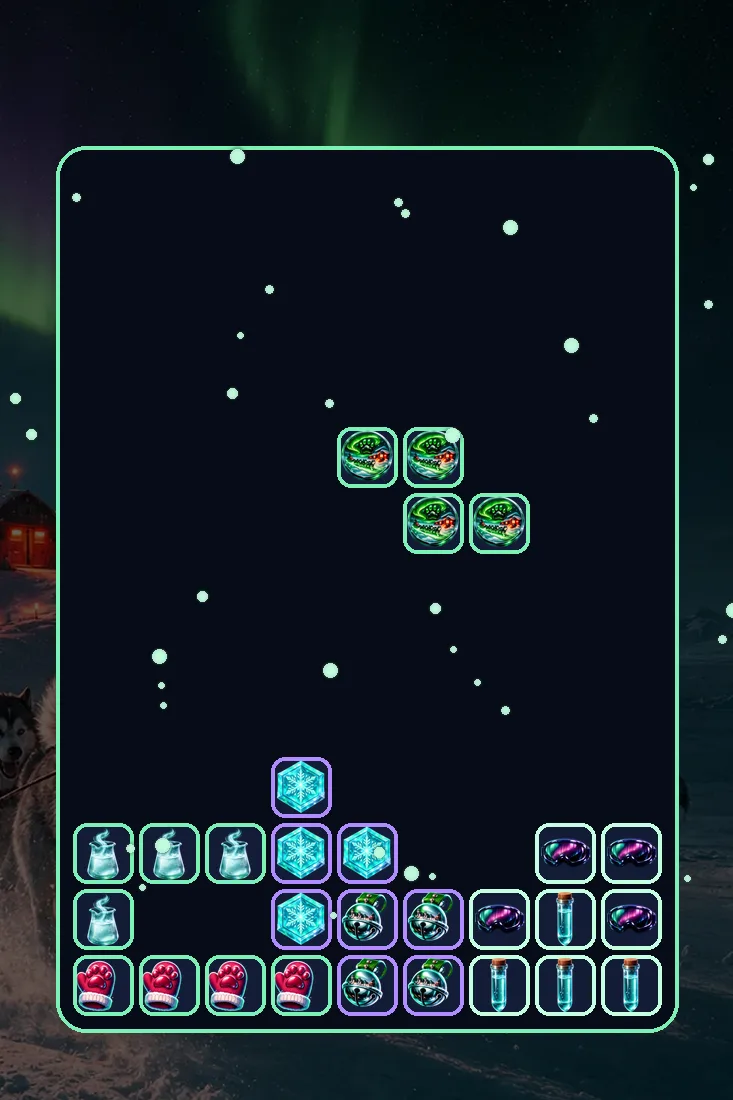
Permafrost Stack takes the falling-block idea everyone half remembers from childhood and fills it with our station kit. The well is ten cells wide and twenty tall. Shapes made of four cells drop in from the top, one at a time, and each of the seven shape types is built from rounded blocks stamped with its own icon, so a paw mitten shape always looks like a paw mitten shape and you learn them by sight.
Fill a row from wall to wall and it clears, dropping everything above it down a step. Leave gaps and the stack creeps upward. Every ten cleared lines the level rises and shapes fall a little faster. A ghost outline at the bottom shows exactly where the current shape will land, a queue shows what is coming next, and a hold box lets you set one shape aside for the perfect moment.
How to play Permafrost Stack
- Press Play and watch the first shape appear at the top of the well with the next ones queued at the side.
- Move it left or right and rotate it until its ghost outline sits where you want it to land.
- Soft drop to lower it faster, or hard drop to send it straight down into the ghost position.
- Tuck an awkward shape into the hold box and swap it back out later when it fits better.
- Fill complete rows to clear them; every ten lines the level rises and the falling speed grows.
Permafrost Stack controls
Getting better at Permafrost Stack
- Keep the surface of your stack as flat as you can; bumpy tops leave nowhere for awkward shapes to sit.
- Leave one column open along a wall for a long straight shape and clear several rows at once.
- Read the next queue before placing the current shape, so you know what has to fit afterwards.
- Use hold for the shape that would wreck your surface right now, not simply the one you dislike.
- Lean on the ghost outline and hard drop once a level gets quick; it saves precious moments.
Seven icons, seven shapes, one glance
In most falling-block games you tell the shapes apart by colour. We wanted something warmer, so each of the seven shape types is textured with one station icon: the red paw mitten, the silver sled bell, the meltwater tube, the frosty beaker, the ice crest, the snow goggles and the den badge. Each block is rounded, like a little tile of carved ice.
It turns out icons are wonderful for quick recognition. After a few rounds your eye stops reading the outline and simply sees goggles or a beaker coming down the queue, and your hands already know where it belongs. Watching a stack of mittens and bells vanish row by row is oddly cheerful, and it gives the whole well a lived-in, kit-room feeling that plain coloured squares never quite manage.
Hold, ghost and queue: three helpers worth using
New players often ignore the helpers at the edge of the well, and they are missing out. The ghost outline shows exactly where the falling shape will come to rest, which removes guesswork and makes the hard drop safe to use. The next queue tells you what is on the way, so you can shape the stack for the pieces you know are coming.
The hold box is the cleverest of the three. Put a shape there and it waits, untouched, until you swap it back in. Strong players keep a long straight shape in hold for a column they have been saving, or park a shape that would otherwise spoil a flat surface. Once you start using hold with purpose, the game shifts from reacting to planning, and that is where it really opens up.
Questions about Permafrost Stack
It is ten cells wide and twenty cells tall, the classic proportions for a falling-block puzzle, and every shape is made of exactly four cells.
Every ten cleared lines the level goes up by one and shapes fall a little faster. The early levels are relaxed, so you have time to learn the controls.
It stores one shape for later. Press C, or the hold control on a touch screen, to tuck the current shape away, then swap it back in when it suits your stack better.